New York, United States
New hotels in SoHo, New York
Cast-iron lofts, flagship stores and the art spaces that outlasted the gallery boom, between Houston and Canal Streets. One tracked project: Delano SoHo New York, the planned conversion of the 46-story tower at 246 Spring Street, on the Hudson Square edge.
Now open in SoHo
No verified openings in SoHo yet.
Coming soon in SoHo
SoHo is the grid of loft buildings between Houston Street to the north and Canal Street to the south. Its east and west edges depend on who draws the map: West Broadway to Lafayette Street in some definitions, Sixth Avenue to Crosby or Lafayette in others. The urban planner Chester Rapkin coined the name in 1962, in a city study titled The South Houston Industrial Area, and New York has since reused the formula for Tribeca, NoHo and Nolita. Nolita and Little Italy start east of Lafayette, Tribeca south of Canal, Greenwich Village north of Houston, and Hudson Square, the former printing district, west of Sixth Avenue.
The tracked project: Delano SoHo New York
Delano SoHo New York is a conversion rather than a new building. It takes over 246 Spring Street, at the corner of Varick Street in Hudson Square, on SoHo's western edge: a 46-story glass tower that opened in 2010 as Trump SoHo and was renamed The Dominick in December 2017. The owner, Cain, bought the roughly 390-room hotel for $175 million and is relaunching it with Ennismore, Accor's lifestyle arm, as Delano's first New York address. It is part of a wider revival of the brand that also covers a restored Delano Miami Beach and a new Delano London.
Little is public beyond that. The plans include new restaurants and bars and event spaces at the top of the tower, but no chef, designer or room rate has been announced.
The address is a short walk from two subway stations: Spring Street on the C and E, at Sixth Avenue, in three or four minutes, and Houston Street on the 1, at Varick, in about five. The shops of Broadway are 12 to 15 minutes east along Spring Street. A block west of the tower, the New York City Fire Museum occupies a 1904 firehouse at 278 Spring Street, and the Hudson River Park piers are about ten minutes west.
Several hotels already operate inside SoHo proper and predate the openings this guide tracks: The Mercer at Prince and Mercer Streets, the Crosby Street Hotel on Crosby Street and the SoHo Grand Hotel on West Broadway, near Canal.
Which side of SoHo
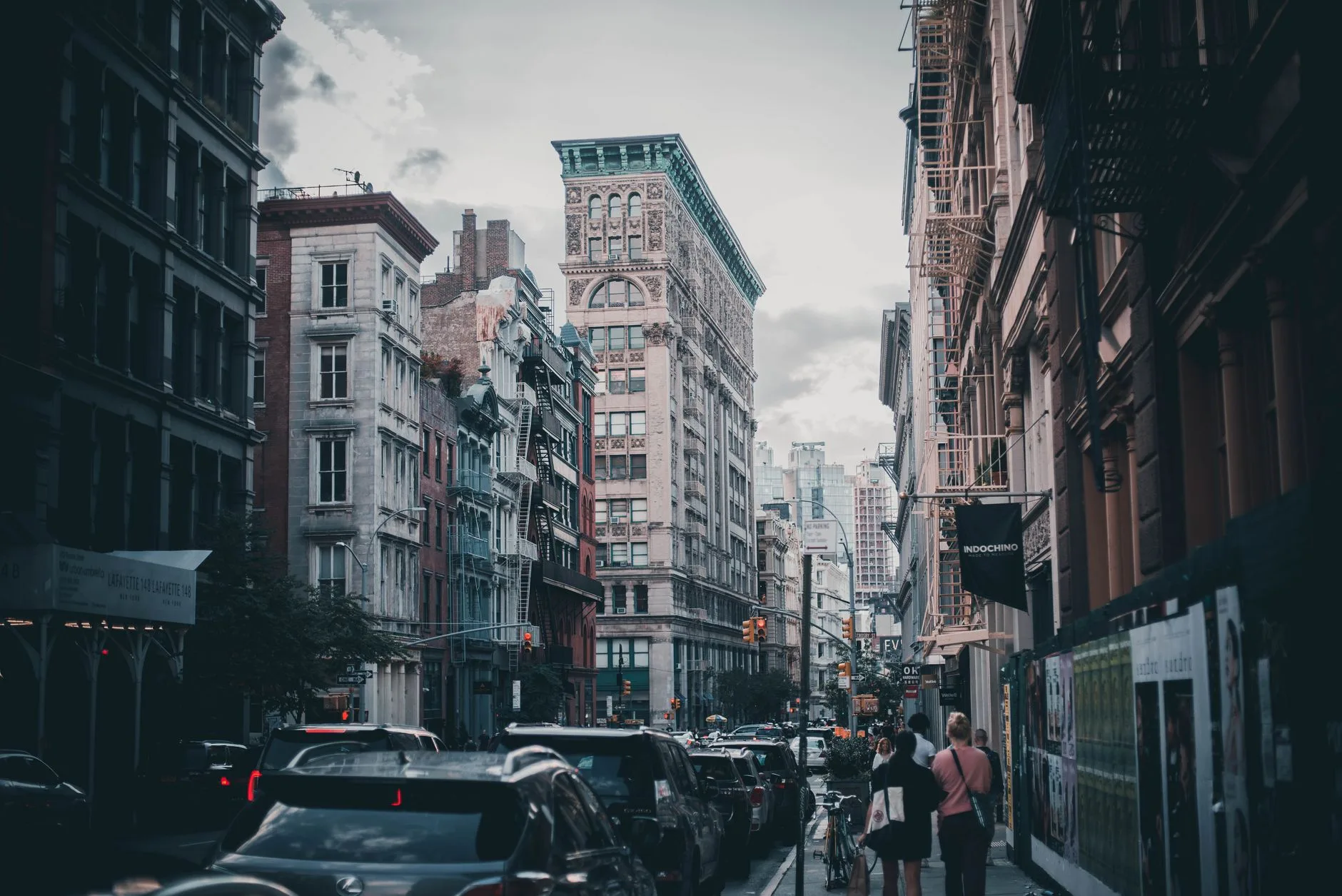
The neighborhood changes character over a few hundred yards. The east side, along Crosby and Lafayette Streets, is narrower and quieter, with Nolita's cafes and Little Italy a block or two beyond. The middle, Broadway and the streets immediately west of it, is the retail core: dense, loud on weekends, and where the historic district's best facades are.
West of West Broadway, on Thompson and Sullivan Streets, the blocks turn residential, with tenements rather than lofts, small restaurants and the Italian-American parish of St. Anthony of Padua at Sullivan and Houston, a reminder that this part of the South Village housed immigrant families long before the art galleries came.
Beyond Sixth Avenue lies Hudson Square, where the Delano project stands. This was the printing district, and its heavy-floored industrial buildings now hold offices, many for media and technology companies. Traffic is the main drawback: Varick Street and the streets around Broome feed the Holland Tunnel to New Jersey, and at rush hour cars back up along them. In the evening, once the offices empty, the sidewalks are quieter than in SoHo proper.
Why the buildings look the way they do
Most of SoHo's facades went up between 1840 and 1880, when the district was a warehouse and light-manufacturing quarter for textile wholesalers and other trades. Cast iron could be molded into columns, cornices and window surrounds far more cheaply than stone could be carved, then bolted onto a building and painted to pass for masonry, and it carried the large open floors and tall windows those businesses needed. Of the roughly 250 cast-iron buildings left in New York, most are here.
Two buildings show the type at its most elaborate. The E. V. Haughwout Building, at the corner of Broadway and Broome Street, was built in 1856 and 1857 for a dealer in china and glassware, with an iron facade by Daniel D. Badger modeled on a Venetian palazzo; it was also the first building to install a commercial passenger elevator. At 28 Greene Street, the five-story "Queen of Greene Street," designed by Isaac F. Duckworth in 1873, stacks bay windows and columns under a mansard roof.
In 1973 the Landmarks Preservation Commission designated the SoHo–Cast Iron Historic District, 26 blocks and about 500 buildings. It became a National Historic Landmark in 1978, and in 2010 the district was extended to cover most of West Broadway and to reach east to Lafayette and Centre Streets. That protection is why so few hotels have been built here from the ground up: new projects tend to reuse existing buildings, or land, like the Delano tower, just outside the protected blocks.
From artists' lofts to flagship stores
By the 1960s much of the manufacturing had left, and artists moved into the empty lofts for the rent, the light and floor plates big enough for large work. They lived there illegally at first, since the zoning was industrial. After pressure from groups such as the Artist Tenant Association, the city amended the rules in 1971 to allow joint live-work quarters for certified visual artists. For the next two decades SoHo was the center of the New York art market, with galleries on the ground floors and studios above.
Rents followed the reputation. Many galleries moved to Chelsea in the mid-1990s, and fashion and design retail took their place. The zoning caught up only recently: after a contested process, the City Council approved a rezoning of SoHo and NoHo in December 2021 that allows housing without the artist certification.
Some of the art era is still open to visitors. Donald Judd bought 101 Spring Street, an 1870 cast-iron building at the corner of Mercer Street, in 1968; the Judd Foundation keeps his home and studio as he arranged them and shows it by guided visit, booked ahead. Walter De Maria's The New York Earth Room, 280,000 pounds of soil filling a loft at 141 Wooster Street since 1977, and The Broken Kilometer, 500 brass rods laid on the floor at 393 West Broadway since 1979, are both maintained by Dia; check opening days before going. The Drawing Center is at 35 Wooster Street, and the Leslie-Lohman Museum of Art at 26 Wooster Street.
Shopping streets, block by block
Broadway between Houston and Canal carries the big chains and the crowds, especially on Saturday afternoons. Prada's store at 575 Broadway was designed by Rem Koolhaas's office OMA and opened in 2001; the Apple Store at 103 Prince Street occupies a former post office. Greene, Mercer and Wooster Streets, one to three blocks west, hold smaller designer boutiques under the best-preserved facades, and the cobblestones on parts of Greene and Wooster have survived. Canal Street, the southern edge, is a different world again: wholesale shops, luggage and electronics stores, and sidewalks that lead east into Chinatown. Housing Works Bookstore Cafe, at 126 Crosby Street, sells donated used books in a high-ceilinged room with a mezzanine, with proceeds going to the charity that runs it.
Where to eat
Balthazar, Keith McNally's brasserie at 80 Spring Street, has served steak frites and seafood towers since 1997. Raoul's, at 180 Prince Street, has been a French bistro since 1975. Fanelli Cafe, on the corner of Prince and Mercer, is a tile-floored bar serving burgers on a corner that has had a bar since the 19th century. Dominique Ansel Bakery, at 189 Spring Street, launched the Cronut in 2013. For a second stop, Mulberry Street in Little Italy is a ten-minute walk east; for eleven days each September it closes to traffic for the Feast of San Gennaro, and the crowds spill toward Lafayette Street.
Getting there and around
Six stations ring the neighborhood: Prince Street (R, W) on Broadway, Spring Street (6) at Lafayette, Broadway–Lafayette Street (B, D, F, M), Canal Street (N, Q, R, W, J, Z, 6), Spring Street (C, E) at Sixth Avenue and Houston Street (1) at Varick. Times Square is about 15 minutes on the R or W from Prince Street, or roughly 45 minutes on foot. The Financial District is ten minutes south on the same trains, and the F from Broadway–Lafayette Street reaches York Street in DUMBO, the first stop in Brooklyn, in about ten minutes. From JFK, the AirTrain to Jamaica connects with the E train, which stops at Spring Street. Within SoHo everything is walkable, and on busy weekends the side streets are faster than Broadway's sidewalks.
When to go
Spring and fall suit the long walks SoHo calls for. Summer weekends crowd the small grid more than most of Manhattan, and the heat makes a gallery a welcome stop between blocks. In December the shop windows are dressed for the holidays, and the cross streets between Broadway's taller buildings can be windy. Weekday mornings, before the stores fill, are the best time to look up at the facades. For the rest of the city, see the New York guide.
Frequently asked questions
Is there a new hotel in SoHo?
One project is tracked: Delano SoHo New York, Ennismore's conversion of the 46-story tower at 246 Spring Street, formerly Trump SoHo and then The Dominick, with about 390 rooms.
Why is it called SoHo?
South of Houston Street. Chester Rapkin, an urban planner, coined the contraction in 1962 in a study of the area's industrial buildings.
Where are the best cast-iron buildings?
On Greene Street, Mercer Street and Broadway between Houston and Canal. The Haughwout Building at Broadway and Broome and the "Queen of Greene Street" at 28 Greene are the best-known single examples.
How far is SoHo from Times Square?
About 15 minutes on the R or W train from Prince Street to Times Square–42nd Street, or roughly 45 minutes on foot.
Is SoHo good for a shopping trip?
Yes. Broadway carries the big chains and flagship stores, while Greene, Mercer and Wooster Streets hold smaller designer boutiques a few minutes apart.
Is SoHo a good base for a first trip to New York?
For a shopping or food-focused trip, yes; for a museum-heavy one, less so. The Financial District is ten minutes south by train, Times Square fifteen minutes north, but the big museums around Central Park take 25 to 35 minutes each way, and rooms in the neighborhood's existing boutique hotels are priced high.
Can you walk from SoHo to Greenwich Village?
Yes. The Village starts on the other side of Houston Street, and Washington Square Park is about ten minutes on foot from Prince Street.