Texas, United States
New hotels in Houston Heights
Houston's first planned suburb, platted in 1891, with a Boulevard esplanade, a bungalow grid under three historic districts and one new hotel on West 20th Street.
Now open in Houston Heights
Coming soon in Houston Heights
No confirmed openings ahead in Houston Heights for now.
Oscar Martin Carter, a former Nebraska bank president, bought 1,756 acres about four miles northwest of downtown Houston in 1891 and laid out a suburb before selling a single house. Streets, alleys, parks, schools and utilities went in first, at a cost the record puts at $500,000. The ground sits some 23 feet above the city, which is where the name comes from, and an electric street railway tied it to downtown. For a traveler in 2026 the useful fact is simpler: this is one of the few Houston neighborhoods where you can leave the car parked for a morning.
A planned suburb, then a long decline, then a rescue
Work on the town began in 1892. The streets running east to west carry the names of American colleges and universities, which is why a visitor finds Yale and Harvard on the same grid. Houston Heights incorporated as its own city in 1896, with William G. Love as first mayor, and grew quickly: roughly 6,000 residents by 1908 and 9,000 by 1915. Cooley Elementary opened in 1894 and Harvard Elementary in 1898. Tax revenue problems eventually pushed the little city to vote for annexation by Houston, which happened in 1918.
The neighborhood began to slide by the 1950s, as growth moved to newer parts of the region. The turn came in 1973, when the newly founded Houston Heights Association started campaigning to preserve what was left. The area was listed on the National Register of Historic Places in 1983, with more than 100 individual structures counted, and the Texas Historical Commission placed a marker on Heights Boulevard in 1991. The city later designated three local historic districts: Houston Heights West in December 2007, Houston Heights East in February 2008, and Houston Heights South in June 2011.
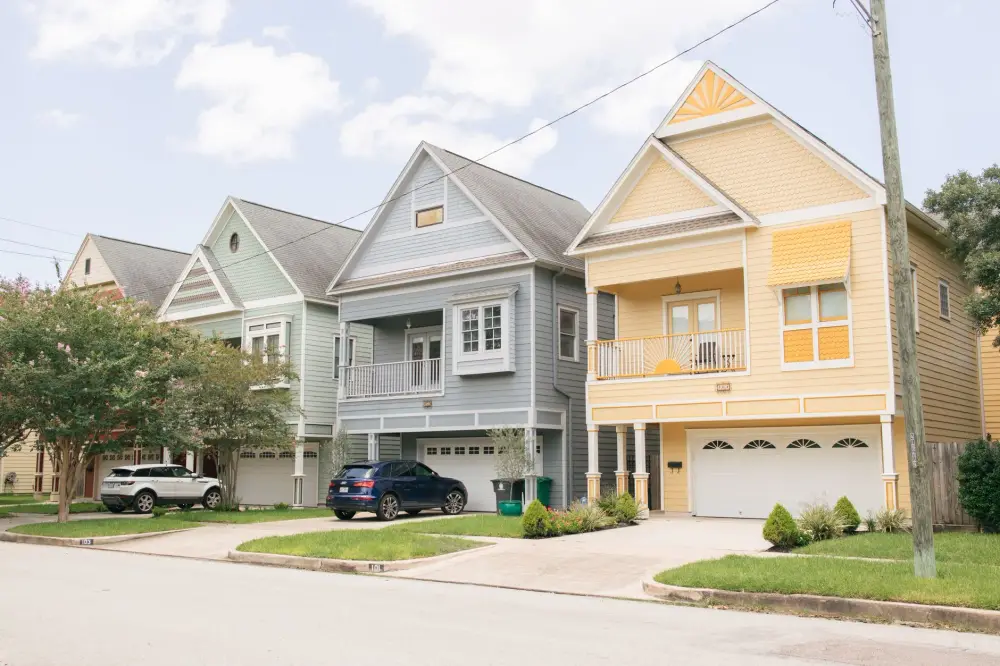
What that protection preserves is housing built between 1891 and 1930: Victorian houses, bungalows and Craftsman cottages, many of them on lots that were never assembled into anything larger.
Heights Boulevard and the 19th Street strip
Heights Boulevard is the best single walk in the neighborhood. Carter's planners drew it in 1892 to 1895 as the focus of the town, with a 60-foot-wide esplanade modeled on Commonwealth Avenue in Boston. It was the first street in the area to be paved, and the streetcar ran along it. The esplanade is still maintained jointly by the city parks department and volunteers from the Houston Heights Association, and it runs through Heights Boulevard Park (numbers 100 to 1900). At 1302 Heights Boulevard stands the neighborhood library, whose building opened in 1925 and was dedicated on March 18, 1926.
A few blocks away, at 12th Street and Yale, the old fire station dates from 1914. It was built to hold city hall, the jail and the fire company under one roof, and Houston used it as a fire station from 1918 until 1995.
The commercial center is 19th Street, now mostly antique dealers, restaurants and small shops. The Heights Theater sits at 339 West 19th Street and was added to the National Register on July 24, 2017.
Trails and the bayou
The Heights Hike and Bike Trail follows the right-of-way of the old Missouri-Kansas-Texas railway for about 2.2 miles. It crosses Heights Boulevard and ends at the White Oak Bayou Greenway near Egbert and May streets, where ramps and stairs drop to the bayou path. From there the bayou trail continues toward downtown for a good many miles, mostly flat and paved. Distances for the full bayou route vary between sources, so check the current Bayou Greenways map before planning a long ride.
For a shorter outing, a loop that combines Heights Boulevard with the neighborhood streets runs about 3.8 miles and can be extended onto the bayou trail.
The dry years
For most of a century the Heights was legally dry. A prohibition on alcoholic beverages passed in 1912, years before the national one,. A 2016 vote ended the ban on grocery stores selling beer and wine, and in 2017 voters dissolved the 1912 ordinance entirely, with 60 percent in favor.
That history shapes the present. Private drinking clubs thrived here when the neighborhood was dry, and the restaurant at the new hotel below draws directly on that tradition. It also explains why bars in the Heights are a recent layer, not an old one.
Where to stay in Houston Heights
At the moment the neighborhood has one new hotel that matters to a visitor: Hotel Daphne. It stands at 347 West 20th Street, one block off the 19th Street strip, and opened in early December 2025 (the operator's release is dated December 5). It is the second Houston property from Bunkhouse Hotels and operates under the JdV by Hyatt banner.
The building is new, five stories of brick wrapped around mature live oaks, designed by the Bunkhouse team with Blanchard A+D, with landscape design by McDugald Steele. The interiors borrow from the Arts and Crafts houses nearby. In the 49 rooms, custom beds carry headboards covered in landscape-print textiles, and the carpet takes its pattern from William Morris's Strawberry Thief. Five terrace rooms of 425 square feet each have balconies over the courtyard, and the penthouse suite measures 1,150 square feet with two bathrooms and a wet bar. Rates started at about $359 a night at opening.
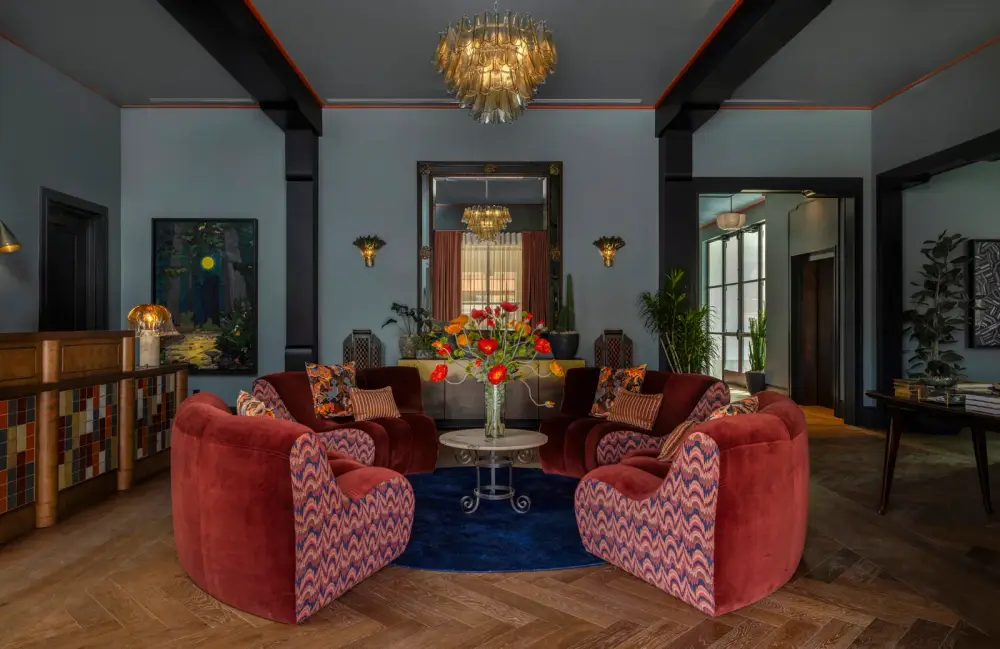
The lobby has a semicircular sofa from Round Top and a concierge desk in handmade tile, and a small shop sells robes and other house-branded goods. A library on the property doubles as a private event room. A pool, a gym and additional rooms are planned for 2027, so the hotel as it stands is smaller than the one its operators describe.
Downstairs is Hypsi, an Italian restaurant led by Terrence Gallivan, a two-time James Beard nominee who previously cooked at Alto in New York. The wine list runs to about 35 bottles, the pasta is made in-house, and a mozzarella cart goes from table to table. Lunch is a separate, shorter sandwich menu, with sandwiches named after local streets such as Heights Boulevard and 20th Street. Hypsi opened for dinner in November 2025, ahead of the rooms.
For anyone who wants a different kind of stay, the nearest alternatives sit in other parts of the city. Downtown Houston is about four miles southeast, Montrose is closer to the museum district and its restaurants, and Galleria & Uptown suits business trips. The wider picture is in the Houston guide.
Which trip the Heights suits
It suits a long weekend with no fixed agenda: antique shops, a dinner a block from the room, a run on the esplanade in the morning. Couples and friends who want a small hotel with a good restaurant downstairs will find that here, and it fits people who like walking past old houses more than past towers.
It does not suit a trip built around meetings downtown or in the Galleria, since both mean a car or rideshare. Convention visitors and families who want a pool should look elsewhere until the planned additions arrive.
Frequently asked questions
Is there a new hotel in Houston Heights?
Yes, Hotel Daphne at 347 West 20th Street. It opened in early December 2025 with 49 rooms, and Hypsi, its Italian restaurant, began dinner service in November 2025.
Why is it called Houston Heights?
Because the site sits about 23 feet higher than downtown Houston. O. M. Carter's land company founded the suburb in 1891 on 1,756 acres and chose the higher ground deliberately.
Was Houston Heights dry?
Yes. Prohibition came in 1912, a 2016 vote allowed grocery stores to sell beer and wine, and the 1912 ordinance was dissolved in 2017 with 60 percent of the vote.
How far is Houston Heights from downtown?
About four miles northwest. Hotel Daphne is a short drive or rideshare from downtown, and the bayou trail also leads that way.
How much does Hotel Daphne cost?
Rooms started at about $359 per night when it opened, according to the hotel's launch coverage. Rates move with season and demand.